
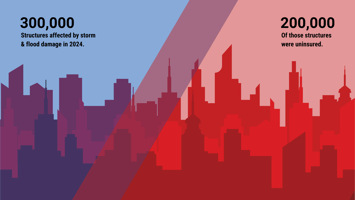
During the National Flood Association's December webinar, Navigating the Ever-Changing Flood...
 Community banks have always managed weather risk. What's changing is how visible, and how urgent, that risk has become.
In a recent American Banker op-ed, Kevin Stiroh, a former senior advisor at the Federal Reserve Board, made the case that the financial institutions most exposed to extreme weather aren't the largest, most diversified banks. They're the small institutions whose borrowers, collateral, and deposits are often concentrated in a single region. A severe January freeze in Florida and a historic tornado outbreak in the Midwest weren't abstract headlines this year. They were balance sheet events for the community banks, savings and loans, and credit unions lending in those areas.
Stiroh's argument boils down to three points that should sound familiar to anyone managing flood and hazard compliance:
- The impact is rising and far-reaching. Weather-related losses aren't staying contained to a handful of high-risk zip codes.
- Timing and severity are deeply uncertain. You can't schedule around it.
- The future won't look like the past. Historical loss data is becoming a less reliable guide, which means static, backward-looking risk models are losing their edge.
Where This Connects to What You're Already Required to Track
Flood risk is the one hazard that's always been federally regulated, which means most lenders already have infrastructure for flood zone determinations and monitoring. But the op-ed's broader point about localized, unpredictable weather exposure extends well past flood zones: wind, hail, fire, and severe storms are hitting balance sheets too, and unlike flood, those hazards aren't federally mandated, so tracking tends to be far less consistent.
That gap is exactly where community banks are most exposed, and exactly where a documented, ongoing monitoring process becomes the difference between a bank that can demonstrate on going risk management versus one relying on origination-date paperwork that's years out of date.
How AFR Services Helps Community Banks Mitigate This Risk
AFR has spent over three decades helping lenders turn compliance obligations into structured, defensible processes. As climate-related risk drivers grow and supervisors lean harder into forward-looking assessment, three parts of what AFR already does become even more relevant:
Flood Zone Determinations. Accurate, defensible determinations give your bank a reliable starting point for identifying flood exposure at origination, the same forward-looking foundation supervisors are asking banks to build on.
Insurance Tracking. Continuous monitoring of coverage status, not just a snapshot at closing, helps catch lapses, gaps, and inadequate coverage before they turn into uninsured losses. For a community bank with concentrated regional exposure, that visibility matters more with every severe weather season.
Life of Loan Support. FEMA map changes don't stop the day a loan closes. Life of Loan monitoring tracks flood zone status for the full life of the loan and automatically issues updated certificates when a property's status changes, giving your bank exactly the kind of ongoing, documented process examiners are increasingly expecting to see.
Local banks are central to the communities they serve, financing the local businesses, farms, and households that keep those communities running. As extreme weather grows more frequent and less predictable, having a partner who can help you see risk coming, document your process, and respond quickly isn't just good practice. It's becoming the standard supervisors expect.
Request a demo today to see how AFR Services can help your team build a forward-looking, examiner-ready approach to climate and hazard risk.