
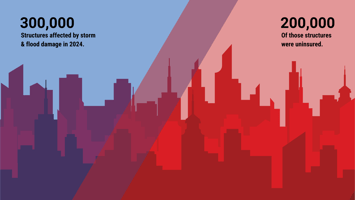
During the National Flood Association's December webinar, Navigating the Ever-Changing Flood...
 A commercial client owns three buildings at one property and two more across town. Each has its own flood policy, with separate documents, renewal dates, and coverage details to manage.
At renewal, it’s worth asking: Does it make sense to schedule multiple structures on one policy to simplify an insured’s flood insurance needs? Would eliminating the paperwork involved with multiple policies benefit the insured? How much would having one effective date and one invoice for everything simplify renewals and payments?
Under the NFIP’s General Property Form, each structure requires its own policy. Some private flood carriers follow that same approach. Others allow agents to combine multiple structures onto a single policy, whether those buildings share a location or are spread across several sites.
That flexibility gives commercial P&C agents another way to approach the placement. Evaluating it requires looking beyond the number of policies.
Start with the structures
Before comparing options, establish exactly what needs coverage.
A single property address may include a main building, a separate warehouse, and a detached maintenance building. A list of locations alone may not identify every structure the client expects to insure.
Review the building schedule with the client and pair it with accurate maps identifying each structure. Confirm latitude and longitude coordinates, building dimensions, uses, and building and contents values. Make sure the maps and schedule clearly identify the same structures so the underwriter can connect each building with its information.
Ask about acquisitions, additions, and shifts in inventory or equipment between buildings since the last placement.
Combining structures onto one policy still requires a clear accounting of each structure. A consolidated placement is only useful if it accurately reflects the account.
One policy does not necessarily mean one shared limit
When reviewing a multi-structure option, establish how the proposed limits apply.
Does each building have a scheduled limit? Is coverage available on a blanket basis? Does an occurrence limit restrict the total available when several buildings sustain damage? Are there sublimits or an annual aggregate that could affect recovery?
These distinctions matter when comparing the proposal with separate policies.
Consider the client’s three buildings at one property. A flood could damage all three during the same event. The agent should be able to explain how the proposed policy would respond across those buildings, including any restrictions on the total payable.
The number on the declarations page needs to be understood in the context of the entire policy.
Look closely at the deductible
A single policy also does not automatically mean a single deductible.
Read how the deductible applies: per building, per location, per occurrence, or through another arrangement specified in the form. Check whether building and contents losses receive different treatment and whether percentage deductibles or minimum amounts apply.
Then walk through a practical scenario with the client: What would the deductible calculation look like if one flood damaged several insured structures?
That discussion makes the comparison more useful than presenting premiums alone. It helps the client understand the amount they could be responsible for before coverage responds.
 Consider how the buildings are exposed together
Separate buildings can share exposure to the same event, even when they have different addresses.
For a client with multiple structures, ask which could reasonably sustain damage together. Consider whether several buildings sit near the same waterway or whether inventory and equipment are concentrated at one site.
Use that discussion to evaluate the proposed limits and deductible structure. A policy that works well for an isolated building loss deserves another look when several structures could be affected at once.
The goal is to help the client understand how the placement fits the way the business owns and uses its properties.
Check the administrative fit
Combining structures may simplify policy administration, but the details still need attention.
Before moving forward, confirm:
- Which structures are eligible for inclusion and how they will be identified.
- How named insureds, ownership entities, and mortgagees will be addressed.
- What documentation each lender needs to review the coverage.
- How existing expiration dates will be coordinated.
- What process applies when the client adds, sells, or changes a building.
A consolidated policy can reduce the number of renewals to manage. It also makes maintaining an accurate schedule important throughout the policy term.
Bring another option to the renewal conversation
While separate policies may remain the right fit for an account, for others, a private policy covering multiple structures may offer a useful alternative. The agent’s role is to compare the available approaches and explain how each would work for that client: which buildings are covered, how limits and deductibles apply, and what happens when the account changes.
At AFR Insurance Services, we utilize our 30+ years of experience to provide agents with options that fit each client’s unique needs, including carrier options to schedule multiple locations on a single policy. Our team can help commercial P&C agents simplify the flood coverage conversation while providing quality coverage for their business clients.
Contact AFR to discuss your next multi-structure account and evaluate the available flood insurance options.